
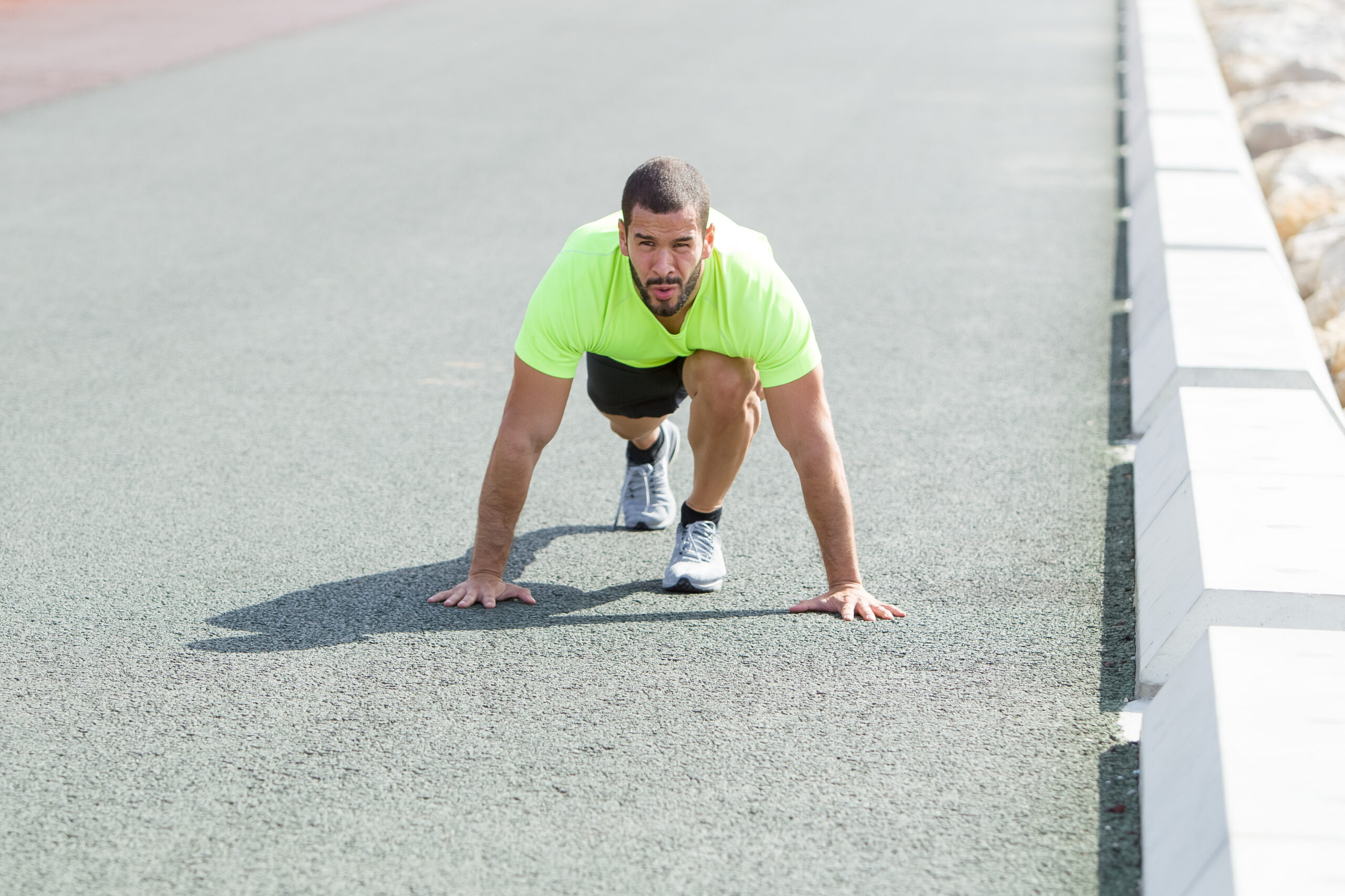
Running injury prevention works by ensuring that every run you do can comfortably tolerate. What you need to do is slowly progress in load, make sure your bodies absorbing mechanisms are strengthened, allow for sufficient recovery before fatigue accumulates and make sure to pay attention when your stride begins to change. You do not need good mechanics or one specific shoe but a repeatable process that ensures the level of stress on the body will be within a level before the body is injured and the fitness is developed.
How To Prevent Running Injuries By Managing Your Injury Threshold
Injuries in runners occur mostly when you increase stress too fast relative to what your tissues can bear. Whether it’s from longer runs, more demanding workouts, hills, speed, poor sleep, or returning after time off, the most common overuse running injuries happen when your body is repeatedly taking similar hits without enough rest to bounce back. Injury prevention for runners is essentially answering this simple but often overlooked question: How much can my legs take THIS WEEK, not last year.
This threshold is highly changeable from week to week. Perhaps a distance that felt like a breeze during a rested block is now too much to sustain when coming off travel or an illness. Maybe a new pair of kicks or two back-to-back hard sessions just tipped you. Highbar Health’s physical therapist’s guide to running injuries is helpful because it helps us think of injury prevention through a physical-therapy lens. However, that lens can be a useful reminder to think about capacity instead of a set of strict guidelines. In other words, rules do help, but they must be modified to fit your current condition.
Rethink The Common Rules About Mileage
The age-old adage to increase running volume slowly can be helpful advice for beginners, but that rule is often too blunt to prevent running injuries on its own. If a five-mile runner adds a half-mile to their long run each week, they may find themselves at greater risk for injury than a fifty-mile runner adding five miles. Total mileage in a week certainly plays a role, but there may be specific weekly changes in the long run or a single-run increase that matter the most. For example, increasing your long run by 4 miles, going from a six to 10-mile run, creates a much higher demand to your body tissues than it seems on the weekly calendar.
Watch Single-Run Increases, Not Just Weekly Totals
To understand how to avoid injury running, consider a week’s biggest run and the most difficult workout in each training week. If your long run increases too far, you take a challenging run (think a downhill trail race or a run after months of easy jogging), you run speed sessions, you can cause an overload and acute running injuries. There are so many potential reasons, and your body doesn’t average all that weekly impact so neatly over 7 days. One session alone can exceed the threshold, even if the total volume does not look alarming yet.
Build Stronger Shock Absorbers With Strength And Mobility
Since running is essentially a succession of single-leg landings, force must be absorbed by the hips, glutes, calves, foot muscles and trunk before focusing on vulnerable areas. “A well-rounded, varied routine may help improve running performance,” the Mayo Clinic Health System website states. The health system also recommends that you prepare in ways that are broader than your run. “In fact, many of the best ways to stay safe during running and to stay healthy are ones that you do before and after your run,” the Mayo Clinic Health System writes on its website on running and avoiding injury.
That sounds straightforward, but what does it really mean? If you search for how to avoid running injuries, don’t go crazy with drills. Start building strength, mobility with controlled range of motion and a plan for consistent training. You need to make your Achilles tendon, your knees and your plantar fascia feel better. This occurs with strengthening of the muscles surrounding them. This is not to discount mobility; just make sure you can control the increased range. Having passive flexibility alone does not help if you cannot maintain your range when you are tired.
Train The Glutes, Hips, And Calves
If the glutes can keep the pelvis level, the hips can keep the knee tracking properly, and the calves can help absorb the repeated push-off and landing forces. This is the essence of how you prevent running injuries, as noted at how to prevent injuries when running. It’s important to know that just because there is weakness, it does not mean it’s going to cause you to hurt. However, it can be a factor, because weakness could be putting more stress on joints and tendons. It’s worth noting that physical therapy can help identify these weaknesses and pinpoint the link in the chain that breaks down first under fatigue.
Strength Exercises To Prevent Running Injuries
When trying to prevent running injuries, pick exercises that are similar to the demands of running. Single-leg squat to a box, reverse lunge, step-down, calf raises in the straight and bent knee position, bridge exercises, side plank and loaded carries will all be great exercises. Squats are great to build strength throughout the whole leg. The reverse lunge is great for training to maintain stability when in the split stance position. The bridges are great to train extension in the hips without using your back. Start with two sets you can perform cleanly, then progress to adding more repetitions or adding weight.

Use Training Load Instead Of Mileage Guesswork
Mileage is only one input. Pace, hills, surface, sleep, stress, strength work, and race efforts all change how hard your body works. Strength Running discusses this broader Running injury prevention view in Strength Running’s guide to injury prevention, which is useful because runners often track distance while ignoring intensity. A slow four miles and a hard four miles do not produce the same fatigue.
If you are asking how to not get injured running, track the pattern more than the single number. Note your longest run, hardest effort, terrain, and soreness the next morning. Keep long run progression boring. If you feel unusually heavy, replace speed with easy running or cross-training before pain appears. Fitness improves from repeated stress followed by recovery, not from proving toughness every workout.
Apply A 110% Progression Guideline
The 110% guideline is a practical alternative to rigid percentage rules: keep the next comparable run or week near 110% of what you recently tolerated. It can reduce running injury risk by limiting sudden jumps while still allowing gradual volume increases. Apply it to distance and intensity. If you extend your long run, do not also add a harder tempo session in the same week.
Schedule Recovery And Cross-Training
Recovery days are not empty space. They are when tissue adapts to the training load you already applied. Cycling and swimming let you build aerobic fitness with less repetitive impact, especially during comeback weeks or after races. Children’s Hospital of Philadelphia highlights healthy routine habits for young runners, and Children’s Hospital of Philadelphia’s running routine guidance reinforces the value of preparation and recovery.
Improve Running Form Without Overcorrecting
Though form can affect impact, drastic alterations can spawn new issues. For instance, a heel-striker that changes their gait to forefoot can result in too much load in the calf and Achilles; a runner that is rigid and erect can lose natural flow and cadence. So, make small adjustments and use them in small doses. Try some of the cues during a low-easy run; once they become automatic, they may be applied during hard workouts and during the run.
The key point here that is often neglected by runners: Efficient movement should feel comfortable. In general, cadence, posture and stride length should help a runner run with less braking force and bouncing, rather than being stiff. As always, Reddit threads (such as this one about beginner injuries) can be useful, but consider them more like peer discussions than medical diagnoses. What matters most is your symptoms and your past injuries.
Adjust Cadence And Stride Length
Cadence changes are appropriate for some runners to reduce overstriding, but they should be changed gradually. For example, if you’re landing with your foot too far in front of your center, then you might reduce the braking forces by taking slightly quicker steps and taking slightly shorter strides. Don’t get hung up on a specific number, as good running form is the result of small adjustments that can be maintained over time, while relaxed, even in later parts of a run.
Run Tall With Relaxed Posture
Here are some specific cues you might apply: keep your torso upright, your shoulders loose, keep your eyes facing forward and keep your hands from crossing your midline. Don’t try to reach forward with your head and chest, rather, try to move your chest forward. Keep your jaw relaxed. Ideally, applying these cues should make it easier to breathe and should cause your foot to hit the ground with a quieter thud. If a cue is causing you to tense up, you should abandon it because a runner that tenses up will absorb impact poorly.

Choose Shoes And Surfaces That Match Your Body
Shoes can influence comfort and load distribution, but there is no guarantee that they will provide protection. The best pair of running shoes usually is one that fits your foot well, feels fine when you run at your normal pace, and doesn’t cause any new discomfort. Changing up your running shoes may be beneficial for some runners who want to change up their load. For example, a runner might use one pair for an easy run, another pair for workouts and a third for long runs.
Different surfaces affect your body differently, and each surface changes both the repetition and the amount of force. Roads are a fairly predictable surface, trails are less predictable, track can have a lot of repetition (e.g. all around a curve), and a treadmill might reduce other factors, like weather, but provides a fairly similar motion. The Boston Children’s Hospital, for example, takes a sports medicine perspective and includes practical advice that might help runners stay safely in their sport on the Boston Children’s Hospital’s running injury prevention page.
Pick Shoes Based On Fit, Comfort, And Wear
When choosing running shoes, consider comfort first. Make sure there is a thumb’s-width of space in front of the longest toe, make sure the foot is securely held and that you don’t feel any rubbing, and make sure the shoe feels comfortable when you jog a short distance. You may want to replace your worn-out running shoes if you feel that they have less cushioning, the outsole has worn unevenly or pain develops when you run only in those shoes. It may not mean that new shoes will fix your pain immediately, but remember there is one caveat. New running shoes may have a different heel height, stiffness or support level, which could change the forces on your tissues more quickly.
Rotate Surfaces When Possible
Road surfaces, such as concrete, are harder and less forgiving than some surfaces and often involve the same repetition. Roads made of asphalt can be somewhat more forgiving than concrete and may involve similar repetition. While trail surfaces can vary in terms of terrain and how your foot strikes the ground, they can put more demand on your muscles and joints. It is not necessarily better for your body to be on softer ground, as uneven surfaces may put stress on your lower limbs. Consider a variety of surfaces for your running. Some runners, for example, use road for controlled workouts, a trail for a slow aerobic session and a treadmill on days that are raining, too hot or too dark to run outside.
Know Common Running Injuries And Early Warning Signs
Some of the more prevalent issues include shin splints, runner’s knee, Achilles tendon pain, plantar heel pain, iliotibial band irritation, and stress fractures. WebMD has a nice general summary about running injuries, but you are not there to self-diagnose every little ache that strikes. You’re there to catch the pattern early, where the symptom comes from, what time it shows up, and whether it’s diminishing or getting worse.
Take a beat with that. Training soreness is usually diffuse, it’s bilateral, and it fades with a warm-up. Pain you should be concerned about is sharper, more focal, getting worse, or linked with a change in the way you run. Morning stiffness in your Achilles, foot pain that’s becoming more localized, or worsening discomfort in your knees on downhill sections should be noticed and addressed before it becomes your new “normal.”
Separate Soreness From Red Flags
You should stop running if the discomfort intensifies during the run, if you are limping, if your foot strike is changing, or if there is swelling. Stop if it is sharp, is focal in nature, or if it comes while resting. Some discomfort after a new workout is OK, but it should get better within a day or two. If you find yourself constantly negotiating with the pain as you go along, then you’re not really working out, are you?
When To Get Help From A Physical Therapist
A Physical therapist can assess gait, strength deficits, mobility limits, tendon capacity, balance, and training history. That matters because the painful site is not always the source of the problem. Knee pain may relate to hip control. Achilles pain may reflect calf weakness, rapid hill exposure, or shoe changes. A good evaluation connects symptoms to load and movement, not just anatomy charts.
Get help when pain lasts more than several runs, returns every time you increase distance, or forces repeated rest cycles. A return-to-run plan should specify run-walk intervals, effort level, recovery days, and strength priorities. UCLA Health discusses marathon-specific risk in UCLA Health’s marathon running injury prevention advice, which is especially relevant when race deadlines tempt you to compress training.
Prevent Running Injuries: Key Context, Examples, And Next Steps
Think about two runners. Runner A runs three easy miles on a given day or across the week and feels like they’ve done enough. Runner B runs a very similar total amount but makes one six mile run a ten mile run on hills. Runner B has altered their tissue demands to a much higher degree. But what does that actually translate to? Monitor the single biggest exposure rather than total mileage.
You can take your next action by making your training visible. Write down your recent easy miles, your longest run, the hardest days, strength workouts, quality of sleep, and how you’re feeling. Make a change to one variable for two weeks. If you’re symptom-free move forward again. If you feel any pain, reduce that specific stimulus. This kind of tracking is much more helpful than your memory. And especially at the beginning when you are still feeling good.
Frequently Asked Questions
Rely on these responses as actionable boundaries, not as a substitute for a clinical diagnosis. If your discomfort is severe, escalating, or altering your movement pattern, have a professional evaluate it rather than attempting to pinpoint every potential cause in isolation.
What Can You Do To Prevent Running Injuries When Increasing Mileage?
While ramping up mileage, approach how to prevent running injuries by adjusting a single primary factor weekly, maintaining your longest effort near what you’ve recently been doing, and never combining speed work, hill repeats, and additional volume in one week. Pay close attention to how you feel the following morning. Should soreness increase, hold the mileage constant or reduce it slightly before attempting further progression.
How Often Should Runners Do Strength Training?
Two sessions of resistance work weekly works well for the average runner, with brief workouts focused on single-leg stability, glute function, calf strength, and core engagement, without compromising your running. A span of twenty to forty minutes will suffice in many cases. Schedule the more demanding portions of your lifting on easy-running days or keep them separate from interval and tempo sessions to ensure adequate recovery.
Is It Better To Reduce Weekly Mileage Or Shorten The Long Run First?
If you’re searching for how to avoid injury running at the start of a flare-up, cut back your longest run first if that session is the most recent or greatest training load. Maintain your easy miles for short durations only if they leave you feeling better. If several consecutive runs trigger pain, reduce both your weekly distance and overall workout intensity.
Can Changing Cadence Reduce Injury Risk?
In regards to how to avoid running injuries when increasing cadence, taking slightly quicker steps can limit overstriding and deceleration forces, yet this approach must be implemented progressively. Incorporate a minor increment during portions of shorter, easy runs. Should your calves, Achilles tendons, or feet signal excessive strain, reduce the step rate and reevaluate your mechanics.
Which Running Surfaces Are Easiest On The Body?
With respect to how to prevent injuries when running, seek a mix, not a flawless pavement. Roads are consistent, mountain paths impose varied loads, tracks offer uniformity yet remain monotonous, and treadmills may offer a viable alternative on bad weather days. Go for the running terrain that allows you to stay loose without forcing a gait modification.
When Should A Runner Stop Running Because Of Pain?
The most definitive approach to how to not get injured running is to cease training when pain increases while you keep running, when you’re limping, when your gait becomes abnormal, or when there’s swelling. You should also halt running if you experience localized pain that’s intense or doesn’t clear. Take a break from running, review your training progression, and ask for a medical evaluation if symptoms resurface.
Summary:
- The bulk of running injuries occur when the training load exceeds the tolerances of the body.
- Although weekly mileage is important, the magnitude of any individual running session and the increase in volume of the long run may also play a role in injury incidence.
- Gluteal, hip, calf, and core strength helps us handle load better.
- Cadence, posture, footwear, and surface can all affect the stress applied to our body if approached properly.
- If running pain lingers, you are limping, swelling is present or the symptoms are progressively getting worse, it is best to see a physical therapist.
Running injury prevention is less about the one great shoe, stretch, or weekly mileage rule than it is about balancing the training demands against what the body is currently able to handle. Work on hip, glute, calf, and core strength. Progress long run distance and volume slowly. Give yourself plenty of recovery time so you do not get too fatigued before making another effort. Make small changes in form and running equipment at a time. Most importantly, listen to your body. If pain causes a gait change, pain gets worse as the run progresses or the pain does not go away with rest, see a physical therapist to return you to the sport.
Sources
- physical therapist’s guide to running injuries
- Strength Running’s guide to injury prevention
- Children’s Hospital of Philadelphia’s running routine guidance
- this one about beginner injuries
- Boston Children’s Hospital’s running injury prevention page
- running injuries
- UCLA Health’s marathon running injury prevention advice